Parameterization Class Family
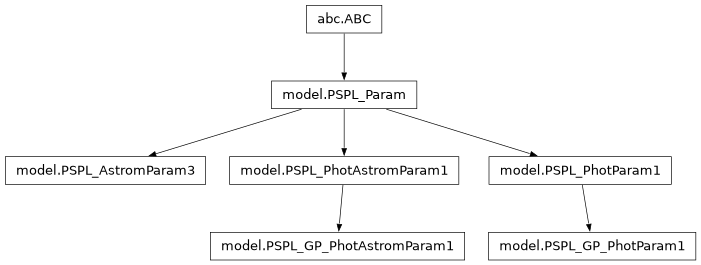
Here is a subsection of the inheritance diagram for the PSPL Parametrization classes showing the AstromParam, PhotParam, and PhotAstromParam structures.
- class model.PSPL_Param(*args, **kwargs)
Bases:
ABC
- class model.PSPL_AstromParam4(t0, u0_amp, tE, thetaE, piS, piE_E, piE_N, xS0_E, xS0_N, muS_E, muS_N, raL=None, decL=None, obsLocation='earth')
Bases:
PSPL_ParamPoint Source Point Lens model for microlensing. This model includes proper motions of the source and the source position on the sky. It is the same as PSPL_PhotAstromParam2 except it fits for baseline instead of source magnitude.
- Attributes:
- t0: float
Time (MJD.DDD) of closest projected approach between source and lens as seen in Solar System barycentric coordinates. This should be close, but not exactly aligned with the photometric peak, as seen from Earth or a Solar System satellite.
- u0_amp: float
Angular distance between the lens and source on the plane of the sky at closest approach in units of thetaE. Can be
positive (u0_amp > 0 when u0_hat[0] > 0) or
negative (u0_amp < 0 when u0_hat[0] < 0).
- tE: float
Einstein crossing time (days).
- thetaE: float
The size of the Einstein radius in (mas).
- piS: float
Amplitude of the parallax (1AU/dS) of the source. (mas)
- piE_E: float
The microlensing parallax in the East direction in units of thetaE
- piE_N: float
The microlensing parallax in the North direction in units of thetaE
- xS0_E: float
RA Source position on sky at t = t0 (arcsec) in an arbitrary ref. frame.
- xS0_N: float
Dec source position on sky at t = t0 (arcsec) in an arbitrary ref. frame.
- muS_E: float
RA Source proper motion (mas/yr)
- muS_N: float
Dec Source proper motion (mas/yr)
Notes
Note
Required parameters if calculating with parallax
raL: Right ascension of the lens in decimal degrees.
decL: Declination of the lens in decimal degrees.
- obsLocation: The observers location for each photometric
dataset (def=[‘earth’]) such as ‘jwst’ or ‘spitzer’. Can be a single string if all observer locations are identical. Otherwise, array of same length as mag_src or b_sff (e.g. other photometric parameters).
- class model.PSPL_AstromParam3(t0, u0_amp, tE, log10_thetaE, piS, piE_E, piE_N, xS0_E, xS0_N, muS_E, muS_N, raL=None, decL=None, obsLocation='earth')
Bases:
PSPL_ParamPoint Source Point Lens model for microlensing. This model includes proper motions of the source and the source position on the sky. It is the same as PSPL_PhotAstromParam3 except it fits only astrometry, no photometry.
- Attributes:
- t0: float
Time (MJD.DDD) of closest projected approach between source and lens as seen in Solar System barycentric coordinates. This should be close, but not exactly aligned with the photometric peak, as seen from Earth or a Solar System satellite.
- u0_amp: float
Angular distance between the lens and source on the plane of the sky at closest approach in units of thetaE. Can be
positive (u0_amp > 0 when u0_hat[0] > 0) or
negative (u0_amp < 0 when u0_hat[0] < 0).
- tE: float
Einstein crossing time (days).
- log10_thetaE: float
The log of the Einstein radius log10(thetaE/mas).
- piS: float
Amplitude of the parallax (1AU/dS) of the source. (mas)
- piE_E: float
The microlensing parallax in the East direction in units of thetaE
- piE_N: float
The microlensing parallax in the North direction in units of thetaE
- xS0_E: float
RA Source position on sky at t = t0 (arcsec) in an arbitrary ref. frame.
- xS0_N: float
Dec source position on sky at t = t0 (arcsec) in an arbitrary ref. frame.
- muS_E: float
RA Source proper motion (mas/yr)
- muS_N: float
Dec Source proper motion (mas/yr)
Notes
Note
Required parameters if calculating with parallax
raL: Right ascension of the lens in decimal degrees.
decL: Declination of the lens in decimal degrees.
- obsLocation: The observers location for each photometric
dataset (def=[‘earth’]) such as ‘jwst’ or ‘spitzer’. Can be a single string if all observer locations are identical. Otherwise, array of same length as mag_src or b_sff (e.g. other photometric parameters).
- class model.PSPL_PhotParam1(t0, u0_amp, tE, piE_E, piE_N, b_sff, mag_src, raL=None, decL=None, obsLocation='earth')
Bases:
PSPL_ParamPSPL model for photometry only.
Point-source point-lens model for microlensing events with photometry only.
Note the attributes, RA (raL) and Dec (decL) are required if you are calculating a model with parallax.
- Attributes:
- t0: float
Time (MJD.DDD) of closest projected approach between source and lens as seen in Solar System barycentric coordinates. This should be close, but not exactly aligned with the photometric peak, as seen from Earth or a Solar System satellite.
- u0_amp: float
Angular distance between the lens and source on the plane of the sky at closest approach in units of thetaE. It can be
positive (u0_amp > 0 when u0_hat[0] > 0) or
negative (u0_amp < 0 when u0_hat[0] < 0).
- tE: float
Einstein crossing time in days.
- piE_E: float
The microlensing parallax in the East direction in units of thetaE.
- piE_N: float
The microlensing parallax in the North direction in units of thetaE
- b_sff: numpy array or list
The ratio of the source flux to the total (source + neighbors + lens) \(b_{sff} = f_S / (f_S + f_L + f_N)\). This must be passed in as a list or array, with one entry for each photometric filter.
- mag_src: numpy array or list
Photometric magnitude of the source. This must be passed in as a list or array, with one entry for each photometric filter.
- raL: float, optional
Right ascension of the lens in decimal degrees.
- decL: float, optional
Declination of the lens in decimal degrees.
- obsLocation: str, optional
The observers location for each photometric dataset (def=[‘earth’]) such as ‘jwst’ or ‘spitzer’. Can be a single string if all observer locations are identical. Otherwise, array of same length as mag_src or b_sff (e.g. other photometric parameters).
- class model.PSPL_PhotParam2(t0, u0_amp, tE, piE_E, piE_N, b_sff, mag_base, raL=None, decL=None, obsLocation='earth')
Bases:
PSPL_ParamPoint source point lens model for microlensing photometry only. This model includes the relative proper motion between the lens and the source. Parameters are reduced with the use of piRel (rather than dL and dS) and muRel (rather than muL and muS). Same as PSPL_PhotParam1, except fits for mag_base instead of mag_src.
- Attributes:
- t0: float
Time (MJD.DDD) of closest projected approach between source and lens as seen in Solar System barycentric coordinates. This should be close, but not exactly aligned with the photometric peak, as seen from Earth or a Solar System satellite.
- u0_amp: float
Angular distance between the lens and source on the plane of the sky at closest approach in units of thetaE. It can be positive (u0_amp > 0 when u0_hat[0] > 0) or negative (u0_amp < 0 when u0_hat[0] < 0).
- tE: float
Einstein crossing time in days.
- piE_E: float
The microlensing parallax in the East direction in units of thetaE.
- piE_N: float
The microlensing parallax in the North direction in units of thetaE
- b_sff: numpy array or list
The ratio of the source flux to the total (source + neighbors + lens) \(b_sff = f_S / (f_S + f_L + f_N)\). This must be passed in as a list or array, with one entry for each photometric filter.
- mag_base: numpy array or list
Photometric magnitude of the base. This must be passed in as a list or array, with one entry for each photometric filter.
Notes
Note
Required parameters if calculating with parallax
raL: Right ascension of the lens in decimal degrees.
decL: Declination of the lens in decimal degrees.
- obsLocation: The observers location for each photometric
dataset (def=[‘earth’]) such as ‘jwst’ or ‘spitzer’. Can be a single string if all observer locations are identical. Otherwise, array of same length as mag_src or b_sff (e.g. other photometric parameters).
- class model.PSPL_PhotAstromParam1(mL, t0, beta, dL, dL_dS, xS0_E, xS0_N, muL_E, muL_N, muS_E, muS_N, b_sff, mag_src, raL=None, decL=None, obsLocation='earth')
Bases:
PSPL_ParamPSPL model for astrometry and photometry - physical parameterization.
A Point Source Point Lens model for microlensing. This model uses a parameterization that depends on only physical quantities such as the lens mass and positions and proper motions of both the lens and source.
Note the attributes, RA (raL) and Dec (decL) are required if you are calculating a model with parallax.
- Attributes:
- mL: float
Mass of the lens (Msun)
- t0: float
Time (MJD.DDD) of closest projected approach between source and lens as seen in Solar System barycentric coordinates. This should be close, but not exactly aligned with the photometric peak, as seen from Earth or a Solar System satellite.
- beta: float
Angular distance between the lens and source on the plane of the sky (mas). Can be
positive (u0_amp > 0 when u0_hat[0] < 0) or
negative (u0_amp < 0 when u0_hat[0] > 0).
- dL: float
Distance from the observer to the lens (pc)
- dL_dS: float
Ratio of Distance from the obersver to the lens to Distance from the observer to the source
- xS0_E: float
RA Source position on sky at t = t0 (arcsec) in an arbitrary ref. frame.
- xS0_N: float
Dec source position on sky at t = t0 (arcsec) in an arbitrary ref. frame.
- muL_E: float
RA Lens proper motion (mas/yr)
- muL_N: float
Dec Lens proper motion (mas/yr)
- muS_E: float
RA Source proper motion (mas/yr)
- muS_N: float
Dec Source proper motion (mas/yr)
- b_sff: numpy array or list
The ratio of the source flux to the total (source + neighbors + lens) \(b_sff = f_S / (f_S + f_L + f_N)\). This must be passed in as a list or array, with one entry for each photometric filter.
- mag_src: numpy array or list
Photometric magnitude of the source. This must be passed in as a list or array, with one entry for each photometric filter.
- raL: float, optional
Right ascension of the lens in decimal degrees.
- decL: float, optional
Declination of the lens in decimal degrees.
- obsLocation: str or list[str], optional
The observers location for each photometric dataset (def=[‘earth’]) such as ‘jwst’ or ‘spitzer’. Can be a single string if all observer locations are identical. Otherwise, array of same length as mag_src or b_sff (e.g. other photometric parameters).
- class model.PSPL_PhotAstromParam2(t0, u0_amp, tE, thetaE, piS, piE_E, piE_N, xS0_E, xS0_N, muS_E, muS_N, b_sff, mag_src, raL=None, decL=None, obsLocation='earth')
Bases:
PSPL_ParamPSPL model for photometry and astrometry – photom-like parameterization
Point Source Point Lens model for microlensing. This model includes proper motions of the source and the source position on the sky.
- Attributes:
- t0: float
Time (MJD.DDD) of closest projected approach between source and lens as seen in Solar System barycentric coordinates. This should be close, but not exactly aligned with the photometric peak, as seen from Earth or a Solar System satellite.
- u0_amp: float
Angular distance between the lens and source on the plane of the sky at closest approach in units of thetaE. Can be
positive (u0_amp > 0 when u0_hat[0] > 0) or
negative (u0_amp < 0 when u0_hat[0] < 0).
- tE: float
Einstein crossing time (days).
- thetaE: float
The size of the Einstein radius in (mas).
- piS: float
Amplitude of the parallax (1AU/dS) of the source. (mas)
- piE_E: float
The microlensing parallax in the East direction in units of thetaE
- piE_N: float
The microlensing parallax in the North direction in units of thetaE
- xS0_E: float
RA Source position on sky at t = t0 (arcsec) in an arbitrary ref. frame.
- xS0_N: float
Dec source position on sky at t = t0 (arcsec) in an arbitrary ref. frame.
- muS_E: float
RA Source proper motion (mas/yr)
- muS_N: float
Source proper motion (mas/yr)
- b_sff: numpy array or list
The ratio of the source flux to the total (source + neighbors + lens) \(b_sff = f_S / (f_S + f_L + f_N)\). This must be passed in as a list or array, with one entry for each photometric filter.
- mag_src: numpy array or list
Photometric magnitude of the source. This must be passed in as a list or array, with one entry for each photometric filter.
- raL: float, optional
Right ascension of the lens in decimal degrees.
- decL: float, optional
Declination of the lens in decimal degrees.
- obsLocation: str or list[str], optional
The observers location for each photometric dataset (def=[‘earth’]) such as ‘jwst’ or ‘spitzer’. Can be a single string if all observer locations are identical. Otherwise, array of same length as mag_src or b_sff (e.g. other photometric parameters).
- class model.PSPL_PhotAstromParam3(t0, u0_amp, tE, log10_thetaE, piS, piE_E, piE_N, xS0_E, xS0_N, muS_E, muS_N, b_sff, mag_base, raL=None, decL=None, obsLocation='earth')
Bases:
PSPL_ParamPoint Source Point Lens model for microlensing. This model includes proper motions of the source and the source position on the sky. It is the same as PSPL_PhotAstromParam4 except it fits for log10(thetaE) instead of thetaE.
- Attributes:
- t0float
Time of photometric peak, as seen from Earth (MJD.DDD)
- u0_ampfloat
Angular distance between the source and the GEOMETRIC center of the lenses on the plane of the sky at closest approach in units of thetaE. Can be
positive (u0_amp > 0 when u0_hat[0] > 0) or
negative (u0_amp < 0 when u0_hat[0] < 0).
- tEfloat
Einstein crossing time (days).
- log10_thetaEfloat
The size of the Einstein radius in (mas).
- piSfloat
Amplitude of the parallax (1AU/dS) of the source. (mas)
- piE_Efloat
The microlensing parallax in the East direction in units of thetaE
- piE_Nfloat
The microlensing parallax in the North direction in units of thetaE
- xS0_Efloat
R.A. of source position on sky at t = t0 (arcsec) in an arbitrary ref. frame.
- xS0_Nfloat
Dec. of source position on sky at t = t0 (arcsec) in an arbitrary ref. frame.
- muS_Efloat
RA Source proper motion (mas/yr)
- muS_Nfloat
Dec Source proper motion (mas/yr)
- b_sffnumpy array or list
The ratio of the source flux to the total (source + neighbors + lenses). One for each filter.
\(b_sff = f_S / (f_S + f_L + f_N)\).
This must be passed in as a list or array, with one entry for each photometric filter.
- mag_basenumpy array or list
Photometric magnitude of the base. This must be passed in as a list or array, with one entry for each photometric filter.
Notes
Note
Required parameters if calculating with parallax
raL: Right ascension of the lens in decimal degrees.
decL: Declination of the lens in decimal degrees.
- obsLocation: The observers location for each photometric
dataset (def=[‘earth’]) such as ‘jwst’ or ‘spitzer’. Can be a single string if all observer locations are identical. Otherwise, array of same length as mag_src or b_sff (e.g. other photometric parameters).
- class model.PSPL_PhotAstromParam4(t0, u0_amp, tE, thetaE, piS, piE_E, piE_N, xS0_E, xS0_N, muS_E, muS_N, b_sff, mag_base, raL=None, decL=None, obsLocation='earth')
Bases:
PSPL_ParamPoint Source Point Lens model for microlensing. This model includes proper motions of the source and the source position on the sky. It is the same as PSPL_PhotAstromParam2 except it fits for baseline instead of source magnitude.
- Parameters:
- t0float
Time of photometric peak, as seen from Earth (MJD.DDD)
- u0_ampfloat
Angular distance between the source and the GEOMETRIC center of the lenses on the plane of the sky at closest approach in units of thetaE. Can be
positive (u0_amp > 0 when u0_hat[0] > 0) or
negative (u0_amp < 0 when u0_hat[0] < 0).
- tEfloat
Einstein crossing time (days).
- thetaE:
The size of the Einstein radius in (mas).
- piSfloat
Amplitude of the parallax (1AU/dS) of the source. (mas)
- piE_Efloat
The microlensing parallax in the East direction in units of thetaE
- piE_Nfloat
The microlensing parallax in the North direction in units of thetaE
- xS0_Efloat
R.A. of source position on sky at t = t0 (arcsec) in an arbitrary ref. frame.
- xS0_Nfloat
Dec. of source position on sky at t = t0 (arcsec) in an arbitrary ref. frame.
- muS_Efloat
RA Source proper motion (mas/yr)
- muS_Nfloat
Dec Source proper motion (mas/yr)
- b_sffnumpy array or list
The ratio of the source flux to the total (source + neighbors + lenses). One for each filter.
\(b_sff = f_S / (f_S + f_L + f_N)\).
This must be passed in as a list or array, with one entry for each photometric filter.
- mag_basenumpy array or list
Photometric magnitude of the base. This must be passed in as a list or array, with one entry for each photometric filter.
Notes
Note
Required parameters if calculating with parallax
raL: Right ascension of the lens in decimal degrees.
decL: Declination of the lens in decimal degrees.
- obsLocation: The observers location for each photometric
dataset (def=[‘earth’]) such as ‘jwst’ or ‘spitzer’. Can be a single string if all observer locations are identical. Otherwise, array of same length as mag_src or b_sff (e.g. other photometric parameters).
- class model.PSPL_PhotAstromParam5(t0, u0_amp, tE, log10_thetaE, piS, piE_E, piEN_piEE, xS0_E, xS0_N, muS_E, muS_N, b_sff, mag_base, raL=None, decL=None, obsLocation='earth')
Bases:
PSPL_ParamPoint Source Point Lens model for microlensing. This model includes proper motions of the source and the source position on the sky. It fits for piEN/piEE and piEE, instead of piEE and piEN.
- Attributes:
- t0float
Time of photometric peak, as seen from Earth (MJD.DDD)
- u0_ampfloat
Angular distance between the source and the lens on the plane of the sky at closest approach in units of thetaE. Can
positive (u0_amp > 0 when u0_hat[0] > 0) or
negative (u0_amp < 0 when u0_hat[0] < 0).
- tEfloat
Einstein crossing time (days).
- log10_thetaEfloat
The size of the Einstein radius in (mas).
- piSfloat
Amplitude of the parallax (1AU/dS) of the source. (mas)
- piEN_piEEfloat
Ratio of piE_N to piE_E.
- piE_Efloat
The microlensing parallax in the East direction in units of thetaE
- xS0_Efloat
R.A. of source position on sky at t = t0 (arcsec) in an arbitrary ref. frame.
- xS0_Nfloat
Dec. of source position on sky at t = t0 (arcsec) in an arbitrary ref. frame.
- muS_Efloat
RA Source proper motion (mas/yr)
- muS_Nfloat
Dec Source proper motion (mas/yr)
- b_sffnumpy array or list
The ratio of the source flux to the total (source + neighbors + lenses). One for each filter.
\(b_sff = f_S / (f_S + f_L + f_N)\).
This must be passed in as a list or array, with one entry for each photometric filter.
- mag_basenumpy array or list
Photometric magnitude of the base. This must be passed in as a list or array, with one entry for each photometric filter.
Notes
Note
Required parameters if calculating with parallax
raL: Right ascension of the lens in decimal degrees.
decL: Declination of the lens in decimal degrees.
- obsLocation: The observers location for each photometric
dataset (def=[‘earth’]) such as ‘jwst’ or ‘spitzer’. Can be a single string if all observer locations are identical. Otherwise, array of same length as mag_src or b_sff (e.g. other photometric parameters).
- class model.PSPL_GP_PhotParam1(t0, u0_amp, tE, piE_E, piE_N, b_sff, mag_src, gp_log_sigma, gp_log_rho, gp_log_S0, gp_log_omega0, raL=None, decL=None, obsLocation='earth')
Bases:
PSPL_PhotParam1
- class model.PSPL_GP_PhotParam1_2(t0, u0_amp, tE, piE_E, piE_N, b_sff, mag_src, gp_log_sigma, gp_rho, gp_log_omega04_S0, gp_log_omega0, raL=None, decL=None, obsLocation='earth')
Bases:
PSPL_PhotParam1Figuring out the new prior parametrization.
- class model.PSPL_GP_PhotParam2(t0, u0_amp, tE, piE_E, piE_N, b_sff, mag_base, gp_log_sigma, gp_log_rho, gp_log_S0, gp_log_omega0, raL=None, decL=None, obsLocation='earth')
Bases:
PSPL_PhotParam2
- class model.PSPL_GP_PhotParam2_2(t0, u0_amp, tE, piE_E, piE_N, b_sff, mag_base, gp_log_sigma, gp_rho, gp_log_omega04_S0, gp_log_omega0, raL=None, decL=None, obsLocation='earth')
Bases:
PSPL_PhotParam2
- class model.PSPL_GP_PhotAstromParam1(mL, t0, beta, dL, dL_dS, xS0_E, xS0_N, muL_E, muL_N, muS_E, muS_N, b_sff, mag_src, gp_log_sigma, gp_rho, gp_log_omega04_S0, gp_log_omega0, raL=None, decL=None, obsLocation='earth')
Bases:
PSPL_PhotAstromParam1
- class model.PSPL_GP_PhotAstromParam2(t0, u0_amp, tE, thetaE, piS, piE_E, piE_N, xS0_E, xS0_N, muS_E, muS_N, b_sff, mag_src, gp_log_sigma, gp_rho, gp_log_omega04_S0, gp_log_omega0, raL=None, decL=None, obsLocation='earth')
Bases:
PSPL_PhotAstromParam2
- class model.PSPL_GP_PhotAstromParam2(t0, u0_amp, tE, thetaE, piS, piE_E, piE_N, xS0_E, xS0_N, muS_E, muS_N, b_sff, mag_src, gp_log_sigma, gp_rho, gp_log_omega04_S0, gp_log_omega0, raL=None, decL=None, obsLocation='earth')
Bases:
PSPL_PhotAstromParam2
- class model.PSPL_GP_PhotAstromParam3(t0, u0_amp, tE, log10_thetaE, piS, piE_E, piE_N, xS0_E, xS0_N, muS_E, muS_N, b_sff, mag_base, gp_log_sigma, gp_rho, gp_log_omega04_S0, gp_log_omega0, raL=None, decL=None, obsLocation='earth')
Bases:
PSPL_PhotAstromParam3Point Source Point Lens with GP model for microlensing. This model includes proper motions of the source and the source position on the sky. It is the same as PSPL_PhotAstromParam4 except it fits for log10(thetaE) instead of thetaE.
- Attributes:
- t0: float
Time (MJD.DDD) of closest projected approach between source and lens as seen in Solar System barycentric coordinates. This should be close, but not exactly aligned with the photometric peak, as seen from Earth or a Solar System satellite.
- u0_amp: float
Angular distance between the lens and source on the plane of the sky at closest approach in units of thetaE. Can be
positive (u0_amp > 0 when u0_hat[0] > 0) or
negative (u0_amp < 0 when u0_hat[0] < 0).
- tE: float
Einstein crossing time (days).
- log10_thetaE: float
log10 of the size of the Einstein radius in (mas).
- piS: float
Amplitude of the parallax (1AU/dS) of the source. (mas)
- piE_E: float
The microlensing parallax in the East direction in units of thetaE
- piE_N: float
The microlensing parallax in the North direction in units of thetaE
- xS0_E: float
RA Source position on sky at t = t0 (arcsec) in an arbitrary ref. frame.
- xS0_N: float
Dec source position on sky at t = t0 (arcsec) in an arbitrary ref. frame.
- muS_E: float
RA Source proper motion (mas/yr)
- muS_N: float
Dec Source proper motion (mas/yr)
- b_sff: numpy array or list of floats
The ratio of the source flux to the total (source + neighbors + lens) \(b_sff = f_S / (f_S + f_L + f_N)\). This must be passed in as a list or array, with one entry for each photometric filter.
- mag_base: numpy array or list of floats
Photometric magnitude of the base. This must be passed in as a list or array, with one entry for each photometric filter.
- gp_log_sigma: float
Guassian process \(log(\sigma)\) for the Matern 3/2 kernel.
- gp_rho: float
Guassian process \({\rho}\) for the Matern 3/2 kernel.
- gp_log_omega04_S0: float
Guassian process \(log(\omega_0^4 * S_0)\) from the power spectral density (PSD) of the DDSHO kernel.
- gp_log_omega0: float
Guassian process \(log(\omega_0)\) from the DDSHO kernel.
- raL: float, optional
Right ascension of the lens in decimal degrees.
- decL: float, optional
Declination of the lens in decimal degrees.
- obsLocation: str or list[str], optional
The observers location for each photometric dataset (def=[‘earth’]) such as ‘jwst’ or ‘spitzer’. Can be a single string if all observer locations are identical. Otherwise, array of same length as mag_src or b_sff (e.g. other photometric parameters).
Notes
Note
raL and decL are required parameters if calculating with parallax
- class model.PSPL_GP_PhotAstromParam4(t0, u0_amp, tE, thetaE, piS, piE_E, piE_N, xS0_E, xS0_N, muS_E, muS_N, b_sff, mag_base, gp_log_sigma, gp_rho, gp_log_omega04_S0, gp_log_omega0, raL=None, decL=None, obsLocation='earth')
Bases:
PSPL_PhotAstromParam4Point Source Point Lens with GP model for microlensing. This model includes proper motions of the source and the source position on the sky. It is the same as PSPL_PhotAstromParam2 except it fits for baseline instead of source magnitude.
- Attributes:
- t0: float
Time (MJD.DDD) of closest projected approach between source and lens as seen in Solar System barycentric coordinates. This should be close, but not exactly aligned with the photometric peak, as seen from Earth or a Solar System satellite.
- u0_amp: float
Angular distance between the lens and source on the plane of the sky at closest approach in units of thetaE. Can be
positive (u0_amp > 0 when u0_hat[0] > 0) or
negative (u0_amp < 0 when u0_hat[0] < 0).
- tE: float
Einstein crossing time (days).
- thetaE: float
The size of the Einstein radius in (mas).
- piS: float
Amplitude of the parallax (1AU/dS) of the source. (mas)
- piE_E: float
The microlensing parallax in the East direction in units of thetaE
- piE_N: float
The microlensing parallax in the North direction in units of thetaE
- xS0_E: float
RA Source position on sky at t = t0 (arcsec) in an arbitrary ref. frame.
- xS0_N: float
Dec source position on sky at t = t0 (arcsec) in an arbitrary ref. frame.
- muS_E: float
RA Source proper motion (mas/yr)
- muS_N: float
Dec Source proper motion (mas/yr)
- b_sff: float
The ratio of the source flux to the total (source + neighbors + lens) \(b_sff = f_S / (f_S + f_L + f_N)\). This must be passed in as a list or array, with one entry for each photometric filter.
- mag_base: float
Photometric magnitude of the base. This must be passed in as a list or array, with one entry for each photometric filter.
- gp_log_sigma: float
Guassian process \(log(\sigma)\) for the Matern 3/2 kernel.
- gp_rho: float
Guassian process \({\rho}\) for the Matern 3/2 kernel.
- gp_log_omega04_S0: float
Guassian process \(log(\omega_0^4 * S_0)\) from the power spectral density (PSD) of the DDSHO kernel.
- gp_log_omega0: float
Guassian process \(log(\omega_0)\) from the SHO kernel.
- raL: float, optional
Right ascension of the lens in decimal degrees.
- decL: float, optional
Declination of the lens in decimal degrees.
- obsLocation: str or list[str], optional
The observers location for each photometric dataset (def=[‘earth’]) such as ‘jwst’ or ‘spitzer’. Can be a single string if all observer locations are identical. Otherwise, array of same length as mag_src or b_sff (e.g. other photometric parameters).
Notes
Note
raL and decL are required parameters if calculating with parallaxFor an explanation of the Guassian process parameters, see Golovich et al. 2019()